New Maps in Seven States May Defy Redistricting Expectations
Independent voters in California, Florida, and others face districts drawn to favor incumbents, but historical voting patterns suggest outcomes may differ from party predictions.
By Joao Menon ·

Midterm elections across the United States hinge on more than just national sentiment; the geography of the vote has been reshaped by new congressional maps in seven states. California, Florida, Missouri, North Carolina, Tennessee, Texas, and Ohio are all using updated district lines for this Tuesday’s election. These changes follow mid-decade redistricting efforts that many observers believe were designed to solidify partisan control. However, political analysts and voters alike note that these new boundaries do not guarantee the results their architects intended.
The Associated Press notes that Republicans attempted to break the historical pattern of midterm losses by utilizing these redistricting efforts. The strategy relied on the assumption that new district lines would protect incumbents and shift the balance of power. Yet, the AP reports that new districts in Florida and other states may not vote as drawn. This discrepancy creates uncertainty for both parties, who are bracing for a closely contested night where one or two seats in either chamber could determine control of Congress.
In the U.S. House, all 435 seats are up for grabs. Republicans currently hold 218 seats, while Democrats hold 214. Democrats need a net gain of three districts to secure a majority, whereas Republicans can afford to lose no more than two seats. Ballotpedia counts 46 battleground districts, with 25 held by Democrats and 21 by Republicans. A significant number of these districts are in the seven states with new maps, making them critical to the final tally. The interplay between local demographics and new district shapes is a primary focus for strategists on both sides.
Florida presents a particularly complex scenario due to its new congressional map. The state’s redistricting was a major target of the Republican effort to secure long-term advantages. However, the AP points out that the new districts may not align perfectly with historical voting trends. In the Senate, a special election is being held for the remainder of the term Marco Rubio was elected to in 2022. This race is considered a battleground, with the 2024 presidential margin in the state favoring Donald Trump by 13.1 points. The outcome here could influence the overall Senate control, where Democrats need a net gain of four seats to take the majority.
Texas and Ohio also utilize new congressional maps this election cycle. In Texas, the Republican Attorney General Ken Paxton is running against Democrat James Talarico for the Senate seat. The AP notes that the Trump administration backed Paxton over Senator John Cornyn in the primary. In Ohio, a special Senate election is taking place for the remainder of the term JD Vance was elected to in 2022. Former Senator Sherrod Brown is challenging incumbent Senator Jon Husted in a race that has drawn national attention. The new district lines in both states are expected to play a role in how votes are counted and how margins are determined.
Missouri, North Carolina, Tennessee, and California round out the group of states with new maps. In North Carolina, the Senate race is open following the retirement of Thom Tillis. Democratic former Governor Roy Cooper is facing Michael Whatley, a former Republican National Committee chair. The AP describes this as a key matchup where the new district lines may influence voter turnout and engagement. In California, the election is largely conducted by mail, and a judge recently ordered the administration to stop demanding that election officials segregate ballots cast by people on lists of suspected noncitizens. This legal development adds another layer of complexity to the voting process in the state.
Voters in these states are expressing mixed emotions about the upcoming vote. Mark Barker of Palm Beach Gardens, Florida, told the AP that he has been following President Trump closely and believes he is doing an awesome job. Conversely, James Moore, a librarian in Raleigh, North Carolina, stated that he is paying more taxes and more for healthcare, reflecting the economic concerns cited in AP-NORC polling. The poll indicates that about seven in ten Americans say the country is heading in the wrong direction, with most blaming the president for high prices.
The Associated Press describes the election as a referendum on the second term, with voters struggling with high prices and anger over an unpopular war with Iran. Republicans are bracing to lose the House while fighting to hold the Senate, while Democrats are cautiously optimistic. The outcome of the races in the seven states with new maps will be crucial in determining whether either party can claim a decisive victory. If Democrats win even one chamber, investigations and possible impeachment proceedings become likely, according to the AP.
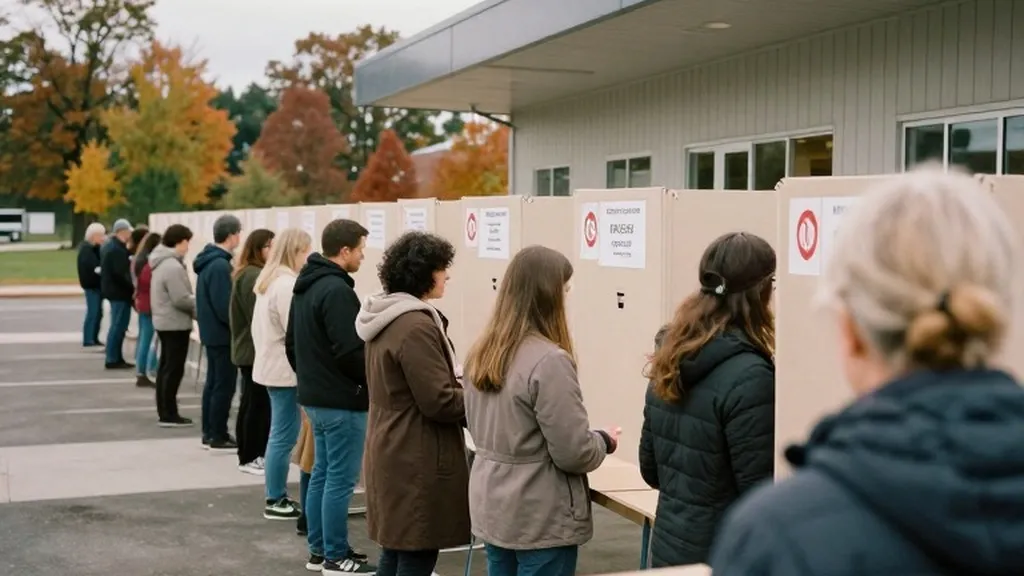
More than 57 million people had already voted as of Monday, surpassing the early vote of four years ago in many closely watched states. The U.S. Postal Service has added hours and staff to ensure mail ballots are counted on time. Wall Street is also watching the results closely, as Reuters notes that the outcome could add to investor concerns about AI spending and debt ceiling negotiations. The combination of new maps, high stakes, and intense campaigning makes this election a pivotal moment for the balance of power in Washington.
As polls close across the seven states with new congressional maps, the focus remains on whether the redistricting efforts will yield the expected results. The interplay between local voter preferences and the newly drawn lines will determine the final composition of Congress. Whether the maps hold true or voters defy the predictions, the results will shape the legislative agenda for the president’s final two years in office. The coming days will reveal if the new districts in California, Florida, Missouri, North Carolina, Tennessee, Texas, and Ohio vote as their architects intended or if the electorate asserts a different will.