Swift Observatory Ends 22-Year Mission With Reentry Near Indonesia
NASA’s gamma ray burst telescope fell to Earth on Wednesday, less than three months after a private rescue attempt failed.
By Joao Menon ·
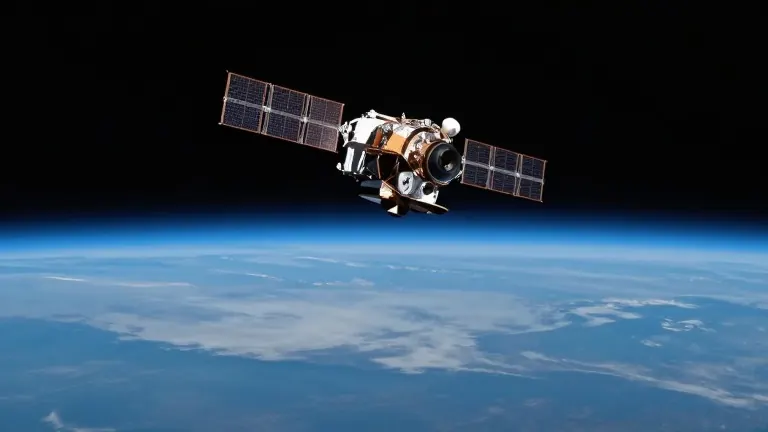
The Swift Observatory, a 1.5-ton spacecraft, plunged to Earth on Wednesday. The reentry occurred near Indonesia, ending a 22-year mission to study cosmic explosions. The U.S. Space Force confirmed the event after tracking the satellite’s declining orbit. The descent was caused by intense solar activity over the past few years, which increased atmospheric drag on the spacecraft.
Swift launched in 2004 with an initial plan for a two-year study of gamma ray bursts and exploding stars. The telescope operated for 11 times longer than expected. During that period, it observed thousands of such events. It often acted as a first responder, alerting other telescopes to investigate specific targets in greater detail. The mission concluded less than three months after a rescue attempt failed.
In July, a private company named Katalyst Space launched a robotic craft designed to boost Swift’s orbit. The three-armed vehicle experienced technical problems after launch. It crashed in September, leaving Swift to deorbit on its own. NASA hired the company for a rapid response effort. It was not immediately clear how much of the spacecraft burned up during reentry. NASA anticipated that some denser components would survive the atmospheric passage.
NASA is now evaluating industry interest in a similar rescue for the Hubble Space Telescope. Hubble, launched in 1990, is also losing altitude due to solar storms. Recent analyses suggest Hubble may reenter Earth by the mid-2030s. The space agency is seeking input from private firms on potential strategies. These options include boosting Hubble’s orbit, upgrading its systems, or guiding it to a controlled reentry.
Any mission to save Hubble would need to occur by 2032. Nicky Fox, NASA’s science mission chief, noted that the agency has more time to explore options for Hubble than it did for Swift. Jared Isaacman, NASA Administrator, said in a statement that Hubble still has important science ahead. He added that the agency should look at every reasonable opportunity to keep the telescope operating as long as possible.
The loss of Swift marks the end of a long era of gamma ray burst monitoring. The telescope provided critical data that helped map the universe’s most violent events. Its retirement follows a pattern of aging satellites being affected by increased space weather. The focus now shifts to protecting Hubble, which remains a primary tool for deep space observation.
Source: The San Bernardino Sun